Rather belatedly, I headed round the corner to my London apiary to apply oxalic acid. It had been a while since I'd opened the hives, and the first time since the unusually cold and snowy spell last month.
I was happy with what I found. Amidala had 5 (not full) seams of bees, Boudicca 7 (interesting since this hive is usually the weaker) and Dido, the nuc, 3. I dribbled 5ml of oxalic acid liquid along each seam. The bees were not impressed and greeted me in the way only grumpy bees can. I think wearing protective gear is probably more important in mid-winter than it is in the height of early summer! I need to nip out to Buckinghamshire to treat my hive there too.
I headed back home to tidy up some old frames which had been hanging around in a box inside my house. Bad news. Many of the frames showed the tell-tail signs of wax-moth (pictured). I destroyed the lot. Interestingly I had some made up but undrawn frames (foundation only) in the same place and these were unaffected. It seems that what I've read is correct: the moth larvae need more than just pure wax to feed on, and foundation is less likely to be affected.
Monday, 10 January 2011
Sunday, 24 October 2010
Feed take-up sporadic
I went to the London site today with the aim of putting back on each of 2 hives the Apiguard tainted honey supers which I'd removed last week. The plan was to remove the contact feeders I'd installed last week and leave each hive with a crown board with a restricted feeder hole above which there were 2 empty, frameless supers with the super of honied frames above that. In theory the bees should take the honey down into the brood box from there. However, I was surprised that whilst this worked for one hive, on the other I found the contact feeder still mostly full. I checked it for function: it seemed fine, with syrup dripping out the bottom when I shook it. Weird - I guess these bees (Hive Amidala) were just preferring the ivy nectar flow instead. Good for them. I left the contact feeder in place and stored the honied super hidden from the bees above that, which I will give access for on my next inspection.
Monday, 18 October 2010
Apiguard and feeding
It's been way too long since the last post, so I'll quickly summarise . . .
I treated all my colonies with Apiguard in early August to coordinate with similar London-wide anti-varroa treatments: 1 sachet in early August and another a fortnight later. I found varroa drop low across all my colonies, so fingers crossed for the winter. I had intended to feed the bees in early September, but somehow other things in life got in the way and I only ended up feeding them yesterday.
Hive Cleopatra (the one on my mother-in-law's roof in Gerrards Cross) was so jammed with honey (and bees) in the brood box that I decided not to put on the gallon contact feeder I had prepared since the bees simply would have had nowhere to put it. All colonies had a limited amount of brood. The 2 proper-sized London colonies looked good, though I gave them each a gallon of feed and I feel confident that with that they should have sufficient stores, especially with the ivy still in bloom for a while yet. The nuc looked a little weaker, and of course it's harder to feed, so I again whacked on my improvised peanut-butter jar feeder and I'll look to do this again a few times before mid-November (a bit late, but there you go).
One problem I am battling with is what to do with supers which I did not extract the honey from since it was unripe or uncapped. Last year I had left these on the hives, though swapped them to be below the brood box. The bees then do the business of moving the honey up into the brood box, and then the super can be removed. I did this with Hive Cleopatra again this year and it worked well. However, I decided against it for the other hives, and in fact have decided against it in general for the future, since it's just too intrusive to move the boxes around: it's really quite cumbersome and disruptive for the bees. So I have 2 supers half-full of capped/semi-capped honey all of which is Thymol (Aipiguard) tainted so not fit for human consumption. I want to give it back to the bees after I get those contact feeders off. I read this week that one way to do it is to put these supers back on the hive at the top, but put 1 or 2 frameless supers in above the brood box first, and put a crown board with reduced hole below the lowest super. That way the bees take the honey down, seeing the honied super simply as a external source. I like this idea and will try it - I very much doubt the bees will try to fill the void with comb at this time of year.
I treated all my colonies with Apiguard in early August to coordinate with similar London-wide anti-varroa treatments: 1 sachet in early August and another a fortnight later. I found varroa drop low across all my colonies, so fingers crossed for the winter. I had intended to feed the bees in early September, but somehow other things in life got in the way and I only ended up feeding them yesterday.
Hive Cleopatra (the one on my mother-in-law's roof in Gerrards Cross) was so jammed with honey (and bees) in the brood box that I decided not to put on the gallon contact feeder I had prepared since the bees simply would have had nowhere to put it. All colonies had a limited amount of brood. The 2 proper-sized London colonies looked good, though I gave them each a gallon of feed and I feel confident that with that they should have sufficient stores, especially with the ivy still in bloom for a while yet. The nuc looked a little weaker, and of course it's harder to feed, so I again whacked on my improvised peanut-butter jar feeder and I'll look to do this again a few times before mid-November (a bit late, but there you go).
One problem I am battling with is what to do with supers which I did not extract the honey from since it was unripe or uncapped. Last year I had left these on the hives, though swapped them to be below the brood box. The bees then do the business of moving the honey up into the brood box, and then the super can be removed. I did this with Hive Cleopatra again this year and it worked well. However, I decided against it for the other hives, and in fact have decided against it in general for the future, since it's just too intrusive to move the boxes around: it's really quite cumbersome and disruptive for the bees. So I have 2 supers half-full of capped/semi-capped honey all of which is Thymol (Aipiguard) tainted so not fit for human consumption. I want to give it back to the bees after I get those contact feeders off. I read this week that one way to do it is to put these supers back on the hive at the top, but put 1 or 2 frameless supers in above the brood box first, and put a crown board with reduced hole below the lowest super. That way the bees take the honey down, seeing the honied super simply as a external source. I like this idea and will try it - I very much doubt the bees will try to fill the void with comb at this time of year.
Monday, 23 August 2010
Big city honey yields
I was just talking with a fellow beek at the Ealing Association who told me he'd got an unprecedented (for him) 100lb average from each of his 8 productive hives. Yes, that's 800lb of honey! That's not the sort of task I'd like to be attempting with my cheapie, plastic, 2 frame, tangential extractor.
It puts my 25lb average for 2 productive hives to shame. I'll be calling a meeting with my bees to discuss improvements in working practices and productivity in future years. Or maybe I'll just aspire to becoming a better beekeeper....
Monday, 16 August 2010
More extraction
I completed extraction of another (and final) super yesterday/today. In total this year I've got about 50lbs from 2 supers, one each from Hive Amidala and Hive Cleopatra. Hive Boudicca and Nuc Dido are unharvested. It's not a great result, but I suppose is satisfactory considering that I started with 2 colonies and now have 4.

Extraction with the cheapie plastic, manual, tangential extractor I have is slow and inefficient, and I've blown the comb through one several frames, which is wasteful. On advice, I did quickly look at extractors "for men" on eBay but they seemed either quite rusty or quite pricey - perhaps this is not the time of year to look. I'll keep an eye out. Certainly going to a radial extractor seems to make more sense.
I'm still uncapping with an uncapping fork, though many people have told me that a cheap "hot air gun" from any DIY store will do the job in a fraction of the time. That's something to investigate for next year. At least I got my nephew and eldest daughter to help me with uncapping for this batch, and they were genuinely helpful - well done little people.
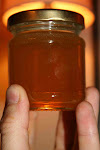
The straining takes a while. This batch of honey came out clearer that the previous super a couple of days ago. I think being more careful in the uncapping made a difference, and I also let it settle for longer.
I dumped the clearer board out in my garden for a short while (there are no hives in the immediate area) - it didn't take the bees and wasps long to find the tiny patches of honey on it.
Oh, it's definitely also worth mentioning that I applied the Apiguard sachet to Hive Cloepatra, so all my colonies are now Apiguarded-up. There colonies were done a "day early" and one a "day late" according to the locally prescribed correct application day, but I'm sure a day or two either way will make no difference. I will apply a second dose in two weeks time, at which point I will remove varroa boards which have been inserted to keep the hives more vapour-tight.
Friday, 13 August 2010
Honey harvest
I put Apiguard on my London hives today (half load on the nuc). I put in entrance reducers and slid in the varroa boards, jamming them tight up to the bottom of the mesh floor to keep all the thymol goodness in as much as possible. In two weeks time I'll apply the second batch.
The excitement of the day came with the honey harvest. One full super yielded about 25lb of honey. My extractor is rubbish. It came as part of a "budget" package with lots of other kit from Thornes. Extracting even one super in the cheap tangential extractor took quite a while with all the faffing with frames and the dodgy handle, though the length of time may have been something to do with the six kids who were "helping" (I like to get mine and their friends involved in this type of thing for their interest). The honey did not come out very clear. I strained it through two different sieves (course and fine) in the same way I did last year, which had previously yielded beautifully clear honey, but this year was not nearly so good. Perhaps it'll clarify over time as the tiny bubbles rise to the top, and maybe I should have left it to settle more before bottling. Anyhow, it tastes beautiful. I'll be popping out to my other hive tomorrow (when the weather clears) to apply varroa and take a super or two off that hive. Between now and then I'll mostly be de-stickying the kitchen!
Thursday, 12 August 2010
Preparing for extraction
I popped up to see some of my hives today to prepare for removing supers over the next couple of days. Hive Amidala has a full super, and another with an awful lot of uncapped honey in it. Oh well - the bees can have that one. I installed my porter bee escape equipped clearer board below the full super. These bee escapes failed dismally last year. Fingers crossed.
Hive Boudicca has no honey to take off. After the troubles with (I think) a swarm earlier in the year and broodlessness right into June I am hardly surprised by the lack of harvestable honey. The concern is whether the colony will be strong enough to make it through the winter, but it's stronger now than at this time last year, so I think I'll proceed with preparing it for winter rather than combining it with another colony.
I aim to take the supers off all my hives in the next couple of days, with varroa treatment (Apiguard) starting on Saturday, which has been mandated as "the" treatment day in north-west London: an attempt at coordination so as not to give the blighters anywhere to hide.
Hive Boudicca has no honey to take off. After the troubles with (I think) a swarm earlier in the year and broodlessness right into June I am hardly surprised by the lack of harvestable honey. The concern is whether the colony will be strong enough to make it through the winter, but it's stronger now than at this time last year, so I think I'll proceed with preparing it for winter rather than combining it with another colony.
I aim to take the supers off all my hives in the next couple of days, with varroa treatment (Apiguard) starting on Saturday, which has been mandated as "the" treatment day in north-west London: an attempt at coordination so as not to give the blighters anywhere to hide.
Subscribe to:
Posts (Atom)